
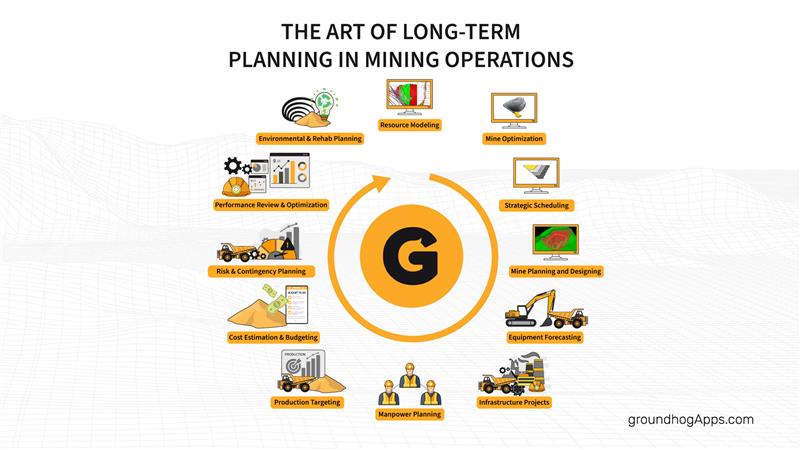
Long-Term Mine Planning is the process of translating a mineral resource into a structured, executable Life-of-Mine plan that can sustain production, manage risk, and deliver value over decades. It sits at the intersection of geology, engineering, operations, finance, and environmental stewardship. More than a technical exercise, Long-Term Mine Planning is a strategic discipline that determines whether a mine remains resilient as conditions change or becomes reactive under pressure.
Unlike short-term planning, which focuses on weeks or months of execution, Long-Term Mine Planning defines the rules of the game. It sets the production envelope, capital strategy, workforce trajectory, and closure obligations long before the first tonne is mined. When done well, it creates alignment across departments and provides early warning when the operation starts drifting off course. When done poorly, the consequences often surface years later as missed targets, rising costs, and constrained options.
This article breaks down the core elements of Long-Term Mine Planning and explains how each contributes to a mine plan that is realistic, adaptable, and operationally grounded.
Resource Modeling in Long-Term Mine Planning
Why Resource Modeling Is the Foundation of Long-Term Mine Planning
Every Long-Term Mine Planning decision rests on the resource model. It defines what exists, where it exists, and how confidently it is understood. Without a robust resource model, production schedules become aspirational and capital decisions become speculative.
Resource modeling establishes the spatial distribution of grade, tonnage, and geological uncertainty. It informs what material can be economically mined, when it can be mined, and how much risk is associated with advancing it early in the mine life.
How Resource Models Support Long-Term Mine Planning
Block models built from drilling, sampling, and geological interpretation form the backbone of Long-Term Mine Planning. These models capture grade variability, domain boundaries, and confidence classifications that directly influence scheduling and cut-off strategies.
In practice, strong Long-Term Mine Planning treats the resource model as a living input. As infill drilling, development sampling, and production data become available, models are refined. Plans that rely on outdated models almost always overstate early production and understate later-life risk.
Mine Optimization as a Core Long-Term Mine Planning Activity
The Role of Mine Optimization in Long-Term Mine Planning
Mine optimization converts geological potential into economic reality. Within Long-Term Mine Planning, optimization defines mining limits, extraction sequences, and value trade-offs under technical and regulatory constraints.
The goal is not to find a single perfect answer. It is to understand the range of viable options and the sensitivities that matter most.
Optimization Methods Used in Long-Term Mine Planning
For surface mines, Long-Term Mine Planning optimization focuses on pit limits, phase sequencing, and cut-off grade strategies. For underground operations, it emphasizes stope geometry, extraction sequencing, and access development.
Modern optimization tools allow planners to test thousands of scenarios that vary metal prices, costs, recovery assumptions, and production constraints. This reveals where value is created, where it is fragile, and where flexibility is required.
Continuous Optimization in Long-Term Mine Planning
Long-Term Mine Planning is not static. Market shifts, geological updates, and operational feedback should trigger re-optimization. Mines that revisit optimization regularly retain optionality. Those that lock into early assumptions often discover too late that their plan no longer fits reality.
Strategic Scheduling in Long-Term Mine Planning
Why Strategic Scheduling Matters in Long-Term Mine Planning
Strategic scheduling translates optimized designs into a time-phased plan across the entire mine life. It defines annual production rates, ore-waste balance, and grade profiles while respecting physical and organizational constraints.
In Long-Term Mine Planning, the schedule is the backbone that connects technical planning to financial forecasting.
Strategic Scheduling Methods in Long-Term Mine Planning
Life-of-mine schedules sequence mining blocks or stopes over multi-year horizons. They account for equipment capacity, haulage profiles, processing limits, development rates, and blending requirements.
Scenario analysis is critical. Strong Long-Term Mine Planning tests how schedules respond to lower development rates, reduced availability, or delayed capital projects.
Rolling Schedules in Long-Term Mine Planning
High-performing operations treat Long-Term Mine Planning schedules as rolling forecasts. Annual updates ensure new constraints and opportunities are surfaced early, when they are still manageable.
Mine Planning and Design within Long-Term Mine Planning
The Importance of Design in Long-Term Mine Planning
Mine planning and design turn strategy into geometry. This includes pits, benches, ramps, declines, stopes, waste dumps, and surface layouts.
Design decisions made early in Long-Term Mine Planning often limit or enable future options. Poor access design, unrealistic ramp gradients, or inflexible layouts can lock a mine into higher costs for decades.
Design Tools Supporting Long-Term Mine Planning
Three-dimensional mine design tools allow engineers to create detailed layouts aligned with schedules and optimization outcomes. Designs are iterated alongside scheduling to ensure physical feasibility and safety.
Design Validation in Long-Term Mine Planning
Designs validate whether the Long-Term Mine Planning assumptions are achievable. They confirm equipment access, geotechnical stability, and development rates, and they provide accurate quantities for cost estimation and rehabilitation planning.
Equipment Forecasting in Long-Term Mine Planning
Why Equipment Forecasting Is Critical to Long-Term Mine Planning
Equipment forecasting ensures that production plans are supported by realistic fleet capacity. Long-Term Mine Planning that ignores equipment availability and reliability almost always overestimates output.
Equipment Forecasting Methods in Long-Term Mine Planning
Fleet models translate production schedules into required machine hours. Availability, maintenance downtime, and replacement cycles are built into forecasts.
Lifecycle analysis determines when equipment should be rebuilt or replaced to balance capital efficiency with reliability.
Equipment Strategy Alignment in Long-Term Mine Planning
Equipment decisions influence infrastructure, manpower, and operating costs. Long-Term Mine Planning must consider future technology shifts, emissions requirements, and automation readiness to avoid stranded capital.
Infrastructure Projects in Long-Term Mine Planning
Infrastructure as a Constraint in Long-Term Mine Planning
Infrastructure enables mining but also constrains it. Power, water, processing capacity, tailings facilities, and haul roads often sit on the critical path.
Long-Term Mine Planning identifies when infrastructure becomes limiting and schedules projects accordingly.
Planning Infrastructure in Long-Term Mine Planning
Infrastructure projects are phased to match production ramp-ups and expansions. Poor timing either constrains production or results in underutilized assets.
Capital-intensive projects require early visibility in Long-Term Mine Planning to avoid reactive decisions later.
Manpower Planning in Long-Term Mine Planning
Workforce Planning as a Long-Term Mine Planning Discipline
Manpower planning ensures the mine has the right skills at the right time. Workforce requirements evolve across construction, ramp-up, steady-state, and closure.
Skill shortages are one of the most underestimated risks in Long-Term Mine Planning.
Integrating Manpower Planning into Long-Term Mine Planning
Workforce forecasts are derived from production schedules and equipment plans. Training lead times, attrition, and succession are built into long-term projections.
Long-Term Mine Planning that ignores workforce realities often faces bottlenecks during ramp-up and expansion phases.
Production Targeting in Long-Term Mine Planning
Setting Realistic Targets in Long-Term Mine Planning
Production targets anchor the mine plan to market demand and processing capacity. In Long-Term Mine Planning, targets must be ambitious yet achievable.
Overstated targets create pressure that cascades into safety, maintenance, and cost performance.
Production Targeting Methods in Long-Term Mine Planning
Targets influence cut-off grades, blending strategies, and stockpile management. They also drive equipment sizing and manpower requirements.
Consistent delivery against targets builds confidence in the Long-Term Mine Planning framework.
Cost Estimation and Budgeting in Long-Term Mine Planning
Why Cost Discipline Matters in Long-Term Mine Planning
Cost estimation translates technical plans into financial reality. Capital, operating, sustaining, and closure costs must all be visible across the mine life.
Long-Term Mine Planning often fails when sustaining capital is underestimated.
Cost Modeling in Long-Term Mine Planning
Costs are built from unit rates applied to planned quantities. Contingency allowances reflect uncertainty and risk.
Budgets are updated regularly to align Long-Term Mine Planning assumptions with actual performance.
Risk and Contingency Planning in Long-Term Mine Planning
Managing Uncertainty in Long-Term Mine Planning
Risk is inherent in mining. Long-Term Mine Planning identifies technical, economic, environmental, and social risks and defines mitigation strategies.
Risk Tools Used in Long-Term Mine Planning
Scenario analysis and sensitivity testing reveal where the plan is vulnerable. Contingency funds and schedule buffers improve resilience.
Risk-aware Long-Term Mine Planning allows proactive decision-making instead of reactive firefighting.
Performance Review and Optimization in Long-Term Mine Planning
Closing the Loop in Long-Term Mine Planning
Performance review compares actual outcomes to planned assumptions. Reconciliation highlights where models, schedules, or costs deviate from reality.
Continuous Improvement in Long-Term Mine Planning
Insights from performance reviews feed back into resource models, schedules, and optimization. Mines that embed this feedback loop maintain alignment between strategy and execution.
Environmental and Rehabilitation Planning in Long-Term Mine Planning
Integrating Closure into Long-Term Mine Planning
Environmental and rehabilitation planning is not an end-of-life task. It influences design, scheduling, and cost estimation from the outset.
Progressive Rehabilitation in Long-Term Mine Planning
Progressive rehabilitation reduces long-term liability and improves regulatory outcomes. Closure costs are planned and funded throughout the mine life.
Conclusion: Why Long-Term Mine Planning Is a Competitive Advantage
Long-Term Mine Planning is not a document that sits on a shelf. It is a living system that guides decisions over decades. Mines that treat Long-Term Mine Planning as an ongoing, integrated discipline consistently outperform those that treat it as a one-time exercise.
In an industry defined by uncertainty, disciplined Long-Term Mine Planning remains one of the strongest predictors of operational resilience, financial stability, and sustainable value creation.